
Scientific Achievement
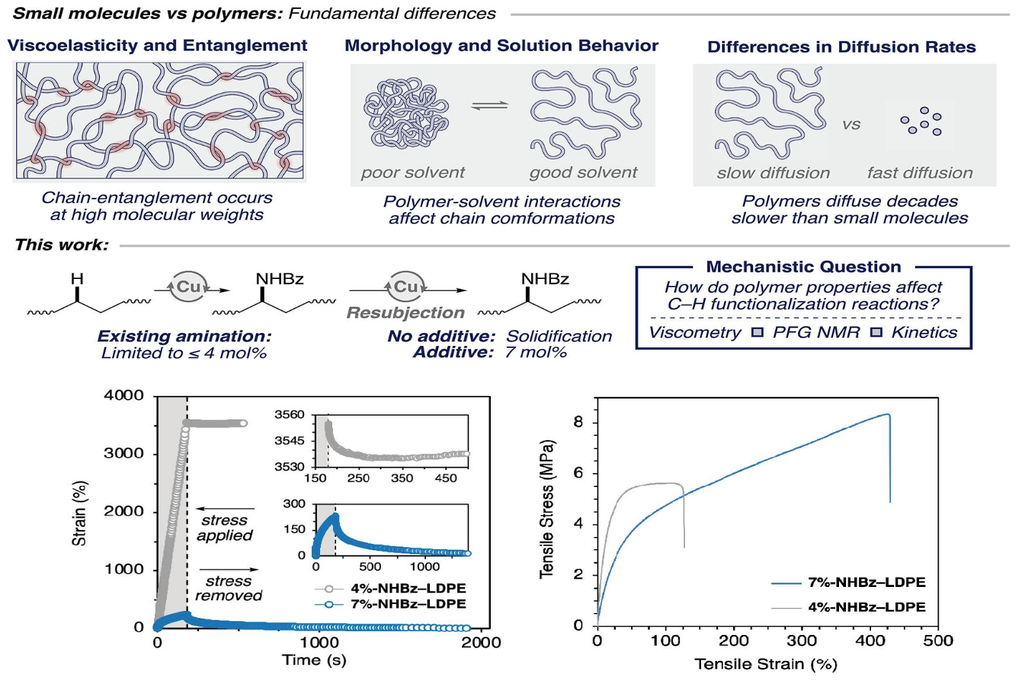
- Researchers in the CUP program states that amidation of polyethylene is self-limiting due to interchain hydrogen-bonding and dipolar interactions suppress catalytic amidation at high conversions
Significance and Impact
- High amide loadings create dynamic physical cross-links that toughen polyethylene and produce strongly elastic, viscoelastic behavior relevant to upcycling waste
Research Details
- Pulsed-field gradient 1H NMR linked interchain interactions to reduced catalytic reactivity
- Alkane cosolvent additives reduced unfavorable interchain interactions, enabling nearly double the achievable amide incorporation in polyethylene
(up to ~7 mol%).
Publication Details
N. R. Ciccia, M. E. McFadden, S. Haber, P. Lahaie-Boivin, Y. Fan, B. A. Helms, J. A. Reimer,
J. F. Hartwig, Journal of the American Chemical Society (2026).
Work was performed at Lawrence Berkeley National Lab and in part by the Molecular Foundry.
